



Carbon Nano series
The Carbon Nano window films incorporate innovative technology that allows carbon particles to create a high heat rejection window film with low haze and glare in comparison to conventional heat rejection chemicals. For carbon particle infusion we use a special technology, which significantly reduces the haze of the final product – window films. These window filbs are based on polyester (PET), which is infused with heat rejection organic material (carbon nanoparticles) during the extrusion process. Besides that, to enhance the clarity of the films, we use only the finest grade PET films from PET film manufacturers such as “Toray”. These films exhibit superb heat shrinkage, which leverages the installation.
Key features
 Stable colour performance |
 High durability |
 UV protection |
 Reflective |
 Long-lasting performance |
 Natural appearance |
 High heat rejection |
 Environment-friendly |
|
High definition clarity |
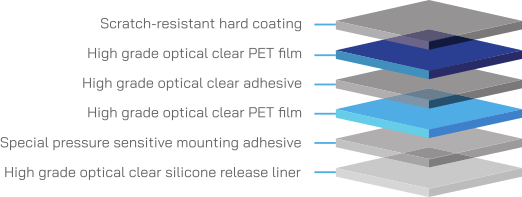
Product structure
The film is based on organic infusion PET film. The Carbon Nano film offers high heat rejection and easy onstallation on all window surfaces while keeping with high optical clarity.
Carbon Nano: CN 50 BK
Specification
| Visible light transmittance | % | 50 |
| Visible light reflectance | % | 11.2 |
| Optical density | % | 0.20 |
| IR Rejection 950 nm | % | 33 |
| UV Rejection | % | 99 |
| Total solar energy rejected | % | 35 |
| Nominal thickness | mil | 2 |
| VLT tolerance | % | ± 3 |
| Scratch resistance | H | 3 |
Properties
| Tensile strength | 24.000 lbs/in² (1.700 kg/cm²) |
| Peel strength | 2500 g/in² (984 g/cm²) |
| Break strength | 56 lbs/in |
| Elongation at break | 160 % |
| Melting point | 260°C - 265°C |
| Haze value | 1.90 |
Carbon Nano: CN 35 BK
Specification
| Visible light transmittance | % | 34 |
| Visible light reflectance | % | 11.0 |
| Optical density | % | 0.50 |
| IR Rejection 950 nm | % | 56 |
| UV Rejection | % | 99 |
| Total solar energy rejected | % | 49 |
| Nominal thickness | mil | 2 |
| VLT tolerance | % | ± 3 |
| Scratch resistance | H | 3 |
Properties
| Tensile strength | 24.000 lbs/in² (1.700 kg/cm²) |
| Peel strength | 2500 g/in² (984 g/cm²) |
| Break strength | 56 lbs/in |
| Elongation at break | 160 % |
| Melting point | 260°C - 265°C |
| Haze value | 1.22 |
Carbon Nano: CN 20 BK
Specification
| Visible light transmittance | % | 20 |
| Visible light reflectance | % | 10.4 |
| Optical density | % | 0.25 |
| IR Rejection 950 nm | % | 55 |
| UV Rejection | % | 99 |
| Total solar energy rejected | % | 55 |
| Nominal thickness | mil | 2 |
| VLT tolerance | % | ± 3 |
| Scratch resistance | H | 3 |
Properties
| Tensile strength | 24.000 lbs/in² (1.700 kg/cm²) |
| Peel strength | 2500 g/in² (984 g/cm²) |
| Break strength | 56 lbs/in |
| Elongation at break | 160 % |
| Melting point | 260°C - 265°C |
| Haze value | 0.75 |
Carbon Nano: CN 5 BK
Specification
| Visible light transmittance | % | 5 |
| Visible light reflectance | % | 10.2 |
| Optical density | % | 0.25 |
| IR Rejection 950 nm | % | 74 |
| UV Rejection | % | 99 |
| Total solar energy rejected | % | 68 |
| Nominal thickness | mil | 2 |
| VLT tolerance | % | ± 3 |
| Scratch resistance | H | 3 |
Properties
| Tensile strength | 24.000 lbs/in² (1.700 kg/cm²) |
| Peel strength | 2500 g/in² (984 g/cm²) |
| Break strength | 56 lbs/in |
| Elongation at break | 160 % |
| Melting point | 260°C - 265°C |
| Haze value | 0.61 |
